Does Purple Mouthwash Stain Your Teeth or Gums? What That Colour Actually Does
It's the first question almost everyone asks before tipping a vivid violet liquid into their mouth: is this going to stain my teeth purple? Fair question — the colour is intense, and nobody wants to trade yellow tones for a lilac tongue. Here's exactly what that pigment does on your teeth, gums and tongue, how long any tint hangs around, and the simple habits that keep the whole process mess-free.
No — used as directed, purple mouthwash doesn't stain teeth. The violet is a water-soluble cosmetic tint that sits on the surface just long enough to cancel the look of yellow tones, then rinses and wears away. Any brief tinge on the tongue or lips fades quickly. The stain risk that IS real: fabrics, benchtops and grout — handle the liquid with care.
What the purple pigment actually is
Colour-correcting rinses get their colour from cosmetic-grade violet dyes — the same family of colourants used in purple shampoo for blonde hair. These are water-soluble surface tints, not oxidising agents: they don't penetrate enamel, they don't react chemically with the tooth, and they don't bind permanently to anything in your mouth.[1]
The job of the pigment is purely optical. Purple is yellow's opposite on the colour wheel, so a sheer violet film over a warm-toned tooth visually neutralises the yellow and the tooth reads whiter. We unpack the full colour science in How Purple Mouthwash Works.
So why doesn't it dye your teeth purple?
Because dose and contact time are tiny. You swish for about 60 seconds, spit, and what remains on the tooth surface is a whisper-thin, translucent veil of tint — enough to shift how the tooth's colour reads to the eye, nowhere near enough to look purple. Enamel is also a dense, non-porous surface compared with, say, cotton or paper, so water-soluble dye has nothing to soak into.[1] Each use then wears away naturally with saliva, eating and drinking — which is also why the brightening effect is temporary and gets refreshed with each use.
One nuance: very porous surfaces in the mouth behave differently from enamel. Heavily textured tongue surfaces, dry or chapped lips, and some older dental restorations can hold tint slightly longer — see below.
Gums, tongue and lips: what to expect
- Gums: healthy gum tissue is constantly bathed in saliva, so any tint typically clears within minutes.
- Tongue: the tongue's textured surface can hold a faint mauve tinge briefly after rinsing — normal, harmless, and it fades fast. A quick water rinse or gentle tongue-scrape clears it.
- Lips: dry, flaky lips can grab a little colour. Rinsing over a sink and dabbing lips with water afterwards prevents it; a swipe of lip balm beforehand works too.
- Dental work: crowns, veneers and composite fillings won't be harmed, but note the corrector's optical effect may read slightly differently on restorations than on natural enamel, since their base tones differ.[2]
The staining risk nobody warns you about
Here's the honest part: the purple that ends up on your bathroom is more of a hazard than the purple in your mouth. Concentrated violet liquid can mark white towels, light benchtops, tile grout and clothing if it splashes and sits. A few habits fix this:
- Pour or tear sachets low over the sink, not at chest height.
- Rinse the sink with water straight after spitting — done immediately, nothing marks.
- Keep the liquid away from towels until you've rinsed your mouth once with water.
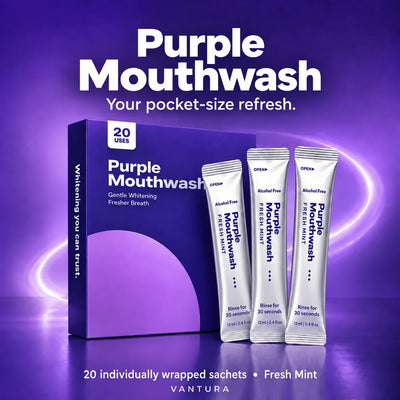
This mess factor is exactly why we moved to pre-measured single-use sachets — no bottle to over-pour, no measuring cup dripping violet onto the vanity, and the dose is right every time.
Twenty pre-measured sachets. No measuring cup, no purple sink, no guesswork — just tear, swish and go.
Shop Purple MouthwashHow to use it tint-free every time
- Brush first. A clean, plaque-free surface takes the pigment evenly, which is what prevents patchiness.
- Swish for the directed time — around 60 seconds. Longer doesn't add brightness; it just extends contact with your tongue.
- Spit thoroughly, then do one quick swish with plain water if you're heading out the door and want zero trace on the tongue.
- Let the effect be the last step. Eating or drinking straight after will wear the veil away sooner.
For the full routine — including how often to use it — see How Often Should You Use Purple Mouthwash?

Frequently asked questions
Will purple mouthwash turn my teeth purple if I use it every day?
How long does the purple tinge on my tongue last?
Does purple mouthwash stain crowns, veneers or fillings?
What should I do if I splash purple mouthwash on clothing or a benchtop?
Is the violet dye safe to have in my mouth?
References & further reading
- Great Lakes Family Dental Group — How purple colour-correcting products work
- EnjoyWhite — Is V34 colour-corrector mouthwash safe for your teeth?