Purple Mouthwash for Sensitive Teeth
Plenty of people want a brighter-looking smile but dread the zing that comes with some whitening products. If your teeth are sensitive, it makes sense to look closely at what a product actually contains and how it works. Here is how a purple colour-correcting rinse differs from peroxide whitening, what is in the sachet, and who should still talk to a dentist first.
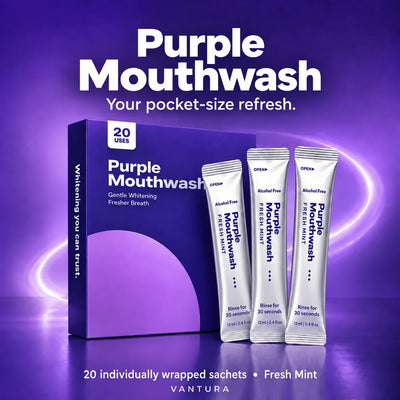
Purple mouthwash works optically, not chemically: a violet tint makes yellow tones look less noticeable. It is formulated without peroxide and without alcohol, two ingredients people with sensitive teeth often find uncomfortable in other products. It is a cosmetic product and is not designed to treat sensitivity, so if your teeth hurt, see your dentist.
Why whitening can feel harsh
Peroxide-based whitening gels and strips work by bleaching, and many people with sensitive teeth find that uncomfortable. Alcohol-based mouthwashes can also sting or dry the mouth. That is why people with sensitivity often avoid whitening altogether, even though they would like their smile to look fresher.
How colour correction is different
A purple rinse does not try to change the tooth itself. It leaves a thin violet veil, and because violet sits opposite yellow on the colour wheel, it cancels the look of yellow tones in reflected light.[1] The effect is immediate and temporary, which means there is no bleaching step to build up over days or weeks. We explain the full mechanism in How Purple Mouthwash Works.
What is in the sachet (and what is not)
- No peroxide. Nothing in the formula is a bleaching agent.
- No alcohol. The rinse is alcohol-free, so it should not carry the sting of alcohol-based mouthwash.
- No abrasives. It is a rinse, not a scrub.
- Pre-measured dose. One sachet per rinse, so you are never guessing how much to use. Check the pack for the full ingredient list.
Worth knowing: sensitivity has many causes, including worn enamel, gum recession and cracked teeth. A cosmetic rinse does not address any of them, which is why persistent sensitivity should be looked at by a professional.
Tips for sensitive mouths
- Start with one use. Try a single sachet and see how your mouth feels before making it a routine.
- Swish gently for about a minute, then spit. There is no benefit to swishing harder.
- Use it after brushing. Gentle brushing with a soft brush keeps enamel comfortable.
- Stop if anything feels irritating and check with your dentist.
If you prefer a strip format, our guides to whitening without the zingers and peroxide-free strips for sensitive teeth cover the other options.
When to see a dentist
If you have sharp or lingering pain, sensitivity that is getting worse, or visible damage to a tooth, a cosmetic product is not the answer. Book a check-up first and ask whether a colour-correcting rinse suits your situation.
Alcohol-free, peroxide-free and pre-measured. One sachet, sixty seconds.
Shop Purple Mouthwash
Frequently asked questions
Is purple mouthwash OK for sensitive teeth?
Does purple mouthwash cause sensitivity?
Is purple mouthwash better than whitening strips for sensitive teeth?
Can purple mouthwash treat tooth sensitivity?
How should I try purple mouthwash if my teeth are sensitive?
References
- Great Lakes Family Dental Group: How purple colour-correcting products work