Purple Mouthwash With Veneers, Crowns & Bonding
If you have veneers, crowns or bonding, you are probably careful about what goes in your mouth. Purple mouthwash is a colour-correcting rinse, so the natural question is whether it does anything to dental work and whether it is worth using alongside it. Here is what a colour corrector does, what it cannot change, and what to ask your dentist.
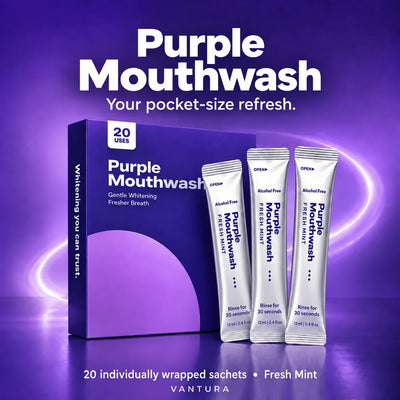
Purple mouthwash does not bleach, so it does not try to change the shade of porcelain, ceramic or composite. It works optically: a violet tint makes yellow tones look less noticeable on the surfaces you can see. It is formulated without peroxide or alcohol. Its most useful job with dental work is making natural teeth that have warmed up look less different from restorations that have not. If your work is recent, check with your dentist first.
Why dental work behaves differently
Whitening products that use peroxide act on natural tooth structure. Porcelain, ceramic and composite do not lighten the same way, which is why people often find their natural teeth drifting yellower over the years while veneers or crowns stay the shade they were made. That gap is one of the most common reasons people look for a gentler, cosmetic option.
What colour correction does on restorations
A purple rinse deposits a thin violet veil. Violet sits opposite yellow on the colour wheel, so it cancels the look of yellow tones in reflected light.[1] It does this on whatever surface it coats, whether that is enamel, porcelain or composite. Three things follow from that:
- It does not alter the material. The veneer or crown is exactly as it was; the tint just changes how the visible surface reads for a few hours.
- It is not a bleaching product. There is no peroxide acting on anything, and no alcohol or abrasive scrubbing.
- It wears off. Saliva, food and drink gradually remove the tint, so nothing builds up or lingers on the restoration.
When natural teeth and veneers do not match
The scenario where people notice a difference is the mismatch: natural teeth that have picked up coffee, tea or wine tones sitting next to restorations that stay bright. A colour corrector can soften the yellow on the natural teeth so the contrast is less obvious, for a few hours at a time.
Realistic expectation: it narrows how visible the difference looks, it does not remove it. If the mismatch bothers you day to day, that is a question for your dentist, who can advise on whitening natural teeth or on replacing a restoration.
For timing, use it after brushing and after your morning coffee for the longest-looking result. We cover routines in How Often Should You Use Purple Mouthwash? and event timing in Photo-Ready Teeth by Morning.
Questions to ask your dentist
- Is there any reason to avoid a colour-correcting rinse with my specific materials?
- Would whitening my natural teeth to match my veneers be worthwhile?
- How long should I wait after new dental work before using cosmetic products?
- Is the yellow I see surface staining, or something a rinse will not touch?
One pre-measured sachet, sixty seconds. Alcohol-free, peroxide-free, and nothing abrasive.
Shop Purple Mouthwash
Frequently asked questions
Is purple mouthwash safe to use with veneers?
Will purple mouthwash whiten crowns or veneers?
Can I use purple mouthwash with bonding or composite fillings?
Can purple mouthwash help my natural teeth match my veneers?
Should I tell my dentist I use purple mouthwash?
References
- Great Lakes Family Dental Group: How purple colour-correcting products work