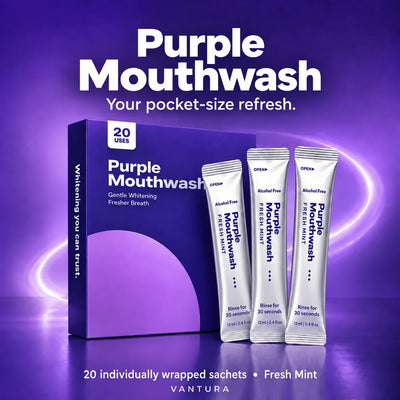
Purple Mouthwash vs Whitening Strips vs LED Kits
Walk down the oral care aisle (or scroll your feed for five minutes) and you'll find three popular routes to a brighter-looking smile: purple colour-correcting mouthwash, whitening strips, and LED whitening kits. They all promise a similar outcome — but they work in completely different ways, suit different people, and come with very different trade-offs.
This guide compares all three honestly, so you can pick the right one for your teeth, your routine and your patience level.
1. The three approaches at a glance
- Purple mouthwash works optically — purple pigments neutralise yellow tones on the surface of your teeth using colour theory, so your smile looks brighter without anything being bleached.
- Whitening strips work chemically — a thin layer of whitening gel held against the teeth, designed to address surface stains over a course of daily applications. Some use peroxide; gentler versions use alternatives like coconut oil and natural brightening agents.
- LED kits work chemically with a light accelerator — a peroxide gel in a mouth tray, paired with an LED light intended to support the gel's action.
2. Purple mouthwash: how it works
Purple sits opposite yellow on the colour wheel, which means the two colours neutralise each other — the same science behind purple shampoo for blonde hair. A purple rinse deposits an ultra-fine, temporary colour-correcting tint across your teeth that offsets yellow undertones, so your smile appears visibly brighter straight after rinsing.
The routine: tear open a sachet, swish for 30 seconds after brushing, spit. Done.
Strengths:
- Visible same-day effect — you can see the difference in the mirror after one use
- No peroxide, no alcohol, no sting — gentle enough for daily use
- Works on veneers, crowns and bonding as well as natural teeth
- Fastest routine of the three by a wide margin
- Doubles as a breath-freshening mouthwash with supportive ingredients like xylitol, hyaluronic acid and pyrophosphate
Honest limitations:
- The effect is optical, not a permanent shade change — think of it as ongoing maintenance, like purple shampoo
- Works best with daily consistency
See: Vantura Purple Mouthwash — 20 single-use sachets, peroxide and alcohol-free.
3. Whitening strips: how they work
Strips hold a thin layer of whitening gel directly against the front teeth for a set wear time — usually 30 to 60 minutes — over a course of days. The sustained contact is what lets the active ingredients work on surface stains.
The routine: apply strips, wear for the recommended time, remove and rinse. Repeat daily across the treatment course (often 14–42 strips per pack).
Strengths:
- Designed for results that build over the course of the treatment
- Targeted contact time on the front teeth — the ones that show when you smile
- Gentler formulas exist — coconut oil strips skip peroxide entirely, and purple colour-correcting strips like Vantura Purple Whitening Strips combine strip format with colour science
Honest limitations:
- Wear time — 30 to 60 minutes where talking, eating and drinking are off the table
- Peroxide-based versions are commonly associated with temporary sensitivity for some users
- Bleaching-based strips don't change the shade of veneers, crowns or bonding
- Strips can slip if not applied carefully
4. LED whitening kits: how they work
LED kits pair a peroxide-based gel (in a mouth tray) with a blue LED light worn over the teeth, with the light intended to support the gel's action. Sessions typically run 10–30 minutes, repeated over days or weeks.
Strengths:
- A structured, treatment-style routine some people enjoy
- Full-arch coverage via the tray
Honest limitations:
- The most involved routine of the three: charging the device, loading gel, sitting with a tray in your mouth for each session
- Peroxide gels carry the same sensitivity considerations as peroxide strips
- Highest upfront cost, plus ongoing gel refills
- Not designed to change the shade of dental work
- A device to clean, store and travel with
5. Side-by-side comparison table
Swipe to compare on mobile →
| Purple Mouthwash | Whitening Strips | LED Kits | |
|---|---|---|---|
| How it works | Optical colour correction | Gel held against teeth | Peroxide gel + LED light |
| Time per use | 30 seconds | 30–60 minutes | 10–30 minutes |
| Visible effect | Same day (optical) | Builds over the course | Builds over sessions |
| Peroxide | No | Varies by product | Usually yes |
| Sensitivity risk | No bleaching involved | Possible with peroxide formulas | Possible with peroxide gels |
| Veneers/crowns | Yes — works on all teeth | Bleaching versions: no | No |
| Equipment | None — sealed sachets | None | Device + gel refills |
| Travel-friendly | Extremely | Yes | Bulky |
| Bonus benefits | Fresh breath + oral care actives | — | — |
Made by Vantura — the Purple Mouthwash.
See the product →6. Sensitivity: the deciding factor for many
Ask anyone who's abandoned a whitening routine why they quit, and the answer is usually one word: sensitivity. Peroxide-based products work by penetrating the enamel, and for some people that process comes with temporary twinges — especially with higher concentrations or longer wear times.
This is where the optical approach genuinely changes the equation. Because purple mouthwash doesn't bleach anything — the brightening is pure colour correction on the surface — there's no peroxide mechanism to trigger that kind of sensitivity in the first place.
For people who've tried strips or LED kits and tapped out, a colour-correcting rinse is often the route back to a brighter-looking smile without the wince. If you experience ongoing tooth sensitivity regardless of products used, that's worth raising with your dentist.
7. If you have veneers, crowns or bonding
This one's simple: porcelain and composite don't respond to bleach. Peroxide strips and LED kits are designed for natural enamel, which means they can brighten your natural teeth while leaving dental work unchanged — creating a visible mismatch.
Purple mouthwash applies its colour correction across every surface evenly, natural or not. If you've invested in veneers, crowns or bonding, it's one of the few brightening products you can use across your whole smile with confidence. (Follow your dentist's aftercare guidance on recently placed work.)
8. Time and effort: what each one asks of you
Over a 20-day stretch:
- Purple mouthwash: 30 seconds a day → 10 minutes total
- Whitening strips: 30–60 minutes a day → 10–20 hours total
- LED kit: 10–30 minutes a session plus setup and cleaning → 4–10+ hours total
Routines only work if you stick to them. The most effective product on paper does nothing sitting in a drawer — and a 30-second step after brushing is the easiest habit of the three to keep.
9. Can you combine them?
Yes — and many people do. A common layered approach:
- Daily: purple mouthwash after the morning brush for ongoing colour correction and fresh breath
- Periodically: a course of strips — such as Purple Whitening Strips or gentler Coconut Oil Whitening Strips — a few times a year
The rinse handles day-to-day maintenance; the strips handle the periodic deeper course. If you're combining peroxide products, space them out and follow each product's directions.
10. Which one should you choose?
Choose purple mouthwash if: you want the fastest routine, visible same-day brightening, zero peroxide, and something that works on dental work as well as natural teeth. Best for coffee/tea/wine drinkers who want low-effort daily maintenance.
Choose whitening strips if: you're happy to commit to daily wear time for a structured treatment course — and pick a peroxide-free format if sensitivity worries you.
Choose an LED kit if: you enjoy a more involved, device-based ritual and don't mind the upfront cost, refills and upkeep.
For most people building a sustainable daily routine, the rinse is the easiest place to start — and the easiest habit to actually keep.

Purple Mouthwash
Colour-correcting purple mouthwash that lifts everyday coffee, tea and wine stains — peroxide-free.
Buy now →Keep reading
This article is for general information only and isn't a substitute for professional dental advice. Individual results may vary. If you have concerns about your oral health, speak with your dentist.