Purple Mouthwash vs Purple Toothpaste: Which Colour Corrector Is Right for You?
Walk down any oral-care aisle (or scroll any beauty feed) and you'll see two purple products promising a brighter-looking smile: purple toothpaste and purple mouthwash. They use the same colour-science trick — but they behave quite differently in real life. If you're deciding between them, this guide breaks down how each works, where each shines, and how to pick the right one for your routine.
Both use violet pigment to visually cancel yellow tones — neither bleaches teeth. Toothpaste combines correcting with brushing but is easy to overuse and can be abrasive; a rinse coats every surface evenly in 60 seconds, with no scrubbing and no grit. Many people use a corrector rinse for the instant optical effect and keep their regular fluoride toothpaste for actual cleaning.
The colour theory both products share
Purple sits opposite yellow on the colour wheel. When a sheer violet tint settles over a warm, yellow-toned surface, the two hues optically cancel each other and the surface reads brighter and whiter to the eye. It's exactly the same principle as purple shampoo for brassy blonde hair, or a green concealer over redness.[1]
Two honest things follow from that. First, the effect is cosmetic and temporary — the pigment doesn't change the actual shade of your enamel, and the look fades as the tint wears away. Second, it works best on yellow-toned discolouration; greyish or brown staining, or discolouration inside the tooth, won't respond the same way.[2] We covered the full mechanism in Does Purple Mouthwash Actually Work?
Purple toothpaste: pros and cons
Purple toothpaste delivers the violet pigment while you brush. That's convenient — no extra step — and the physical brushing also removes surface plaque and fresh stains, which helps brightness in its own right.
The trade-offs:
- Uneven coverage. Pigment goes where your brush goes. Miss the back teeth or the edges near the gumline and the correction is patchy.
- Abrasivity. Some whitening and colour-correcting pastes lean on abrasives for stain removal, which dentists caution against over-using — especially for people with sensitivity or enamel wear.[2]
- Formula compromise. Many purple pastes are used instead of your regular toothpaste, and not all contain fluoride — so you can end up trading cavity protection for colour correction.
- Mess factor. Concentrated purple paste is notorious for staining sinks, towels and toothbrush bristles.
Purple mouthwash: pros and cons
A colour-correcting rinse takes the opposite approach: swish for around 60 seconds and the liquid carries the violet pigment across every surface at once — front teeth, back teeth, between teeth — without any scrubbing.
- Even, all-over coverage. Liquid reaches surfaces a brush misses, so the optical effect is uniform.
- Zero abrasion. There's no scrubbing involved, which makes a rinse a comfortable option for people with sensitive teeth who find peroxide whiteners or gritty pastes unpleasant.[3]
- It's an add-on, not a swap. A rinse slots in after your normal brushing, so you keep your regular fluoride toothpaste and everything it does.
- The trade-off: a rinse doesn't physically clean. It corrects tone; it doesn't remove plaque. It's a finishing step, not a hygiene step.
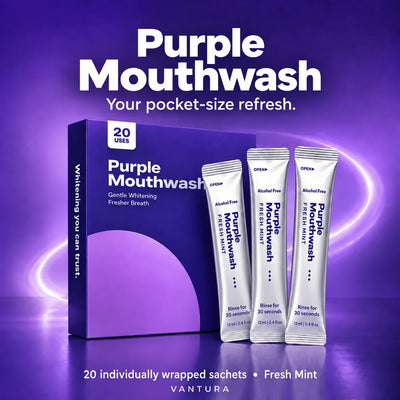
Sachet tip: pre-measured single-dose sachets solve the two classic rinse problems — over-pouring and purple splashes around the sink — and they travel well for events, trips and gym bags.
Head to head: which should you choose?
| Purple toothpaste | Purple mouthwash | |
|---|---|---|
| How it applies pigment | Where the brush touches | Evenly, across every surface |
| Abrasion | Possible (varies by formula) | None — no scrubbing |
| Fits your routine as | Often a toothpaste replacement | An extra 60-second step after brushing |
| Best for | People who want one combined step | Sensitive teeth, even coverage, travel |
| Whitens enamel? | No — optical only | No — optical only |
| Speed of visible effect | Immediately after use | Immediately after use |
If you want one product that brushes and corrects in a single step — and your teeth aren't sensitive — a purple toothpaste can suit you. If you want even coverage, no added abrasion, and a step that doesn't interfere with the toothpaste you already trust, a rinse is the cleaner fit. And because they do the same optical job, there's no benefit in doubling up daily — pick the format you'll actually use consistently.
Want the rinse route? Our alcohol-free, peroxide-free purple mouthwash comes in 20 pre-measured sachets — no measuring cup, no purple sink.
Shop Purple MouthwashWhat neither product can do
Honesty corner. Neither a purple paste nor a purple rinse changes the underlying colour of your teeth. Both are colour correctors — think of them as makeup for your smile, refreshed with each use. If you want a longer-lasting change in the actual shade of surface stains, that's the territory of whitening strips and professional treatments — we compared the categories in Purple Mouthwash vs Whitening Strips vs LED Kits. Many people pair the two: strips for gradual change, a purple rinse for an instant boost before you head out the door.[3]

Frequently asked questions
Can I use purple mouthwash and purple toothpaste together?
Which works faster — purple toothpaste or purple mouthwash?
Is purple mouthwash safe for sensitive teeth?
Does purple toothpaste or mouthwash actually whiten teeth?
Should I use purple mouthwash before or after brushing?
References & further reading
- Great Lakes Family Dental Group — What Is Purple Toothpaste & How Does It Work?
- MySmile — Does Purple Toothpaste Actually Whiten Teeth? Real Whitening vs. Temporary Brightening
- NewMouth — Colour-corrector review: what V34-style products do and don't do